Alex Lazard
Painting Without a Plan
Alex Lazard welcomed us into his studio in San Miguel de Allende, among stacked canvases, paint-crusted brushes and a floor that tells the story of every painting. This is a conversation about improvising, letting go, and creating from nothing.
Throughout our conversation, Alex Lazard never stops drawing.
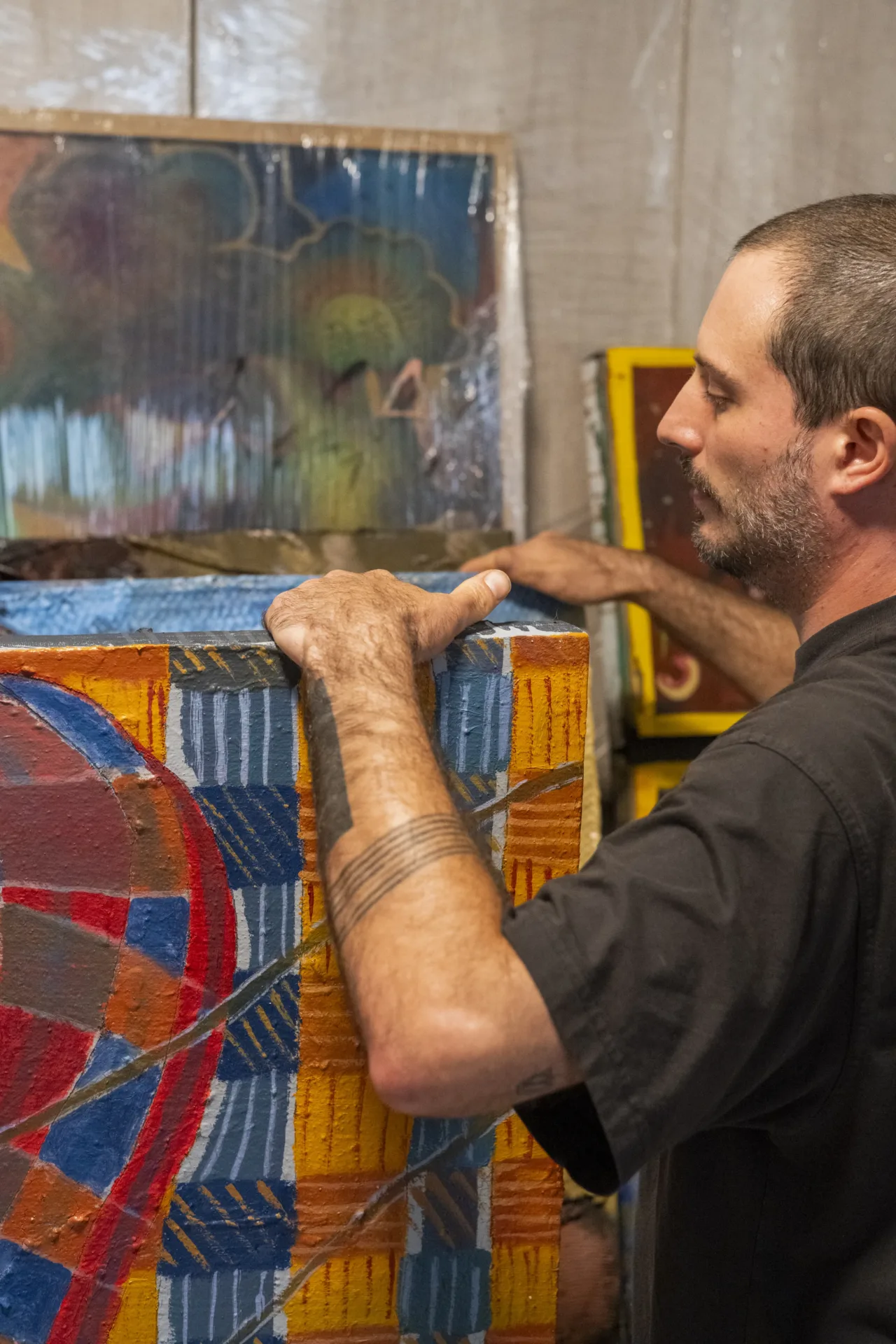
He talks while his pencil moves across the pages of his notebook. One page, then another. When he pauses, his fingers tap the table as if he were still sitting behind a drum kit. Music was part of his path toward painting, and some of that rhythm lives on in the way he works: improvising, following whatever emerges, never knowing in advance how it will end.
For fifteen years, he has painted without sketches. He begins with one shape, then another, allowing the painting to find its own direction. Sometimes he spends an entire day working on a piece, only to paint over it the next. Beneath many of his paintings lie others we will never see.
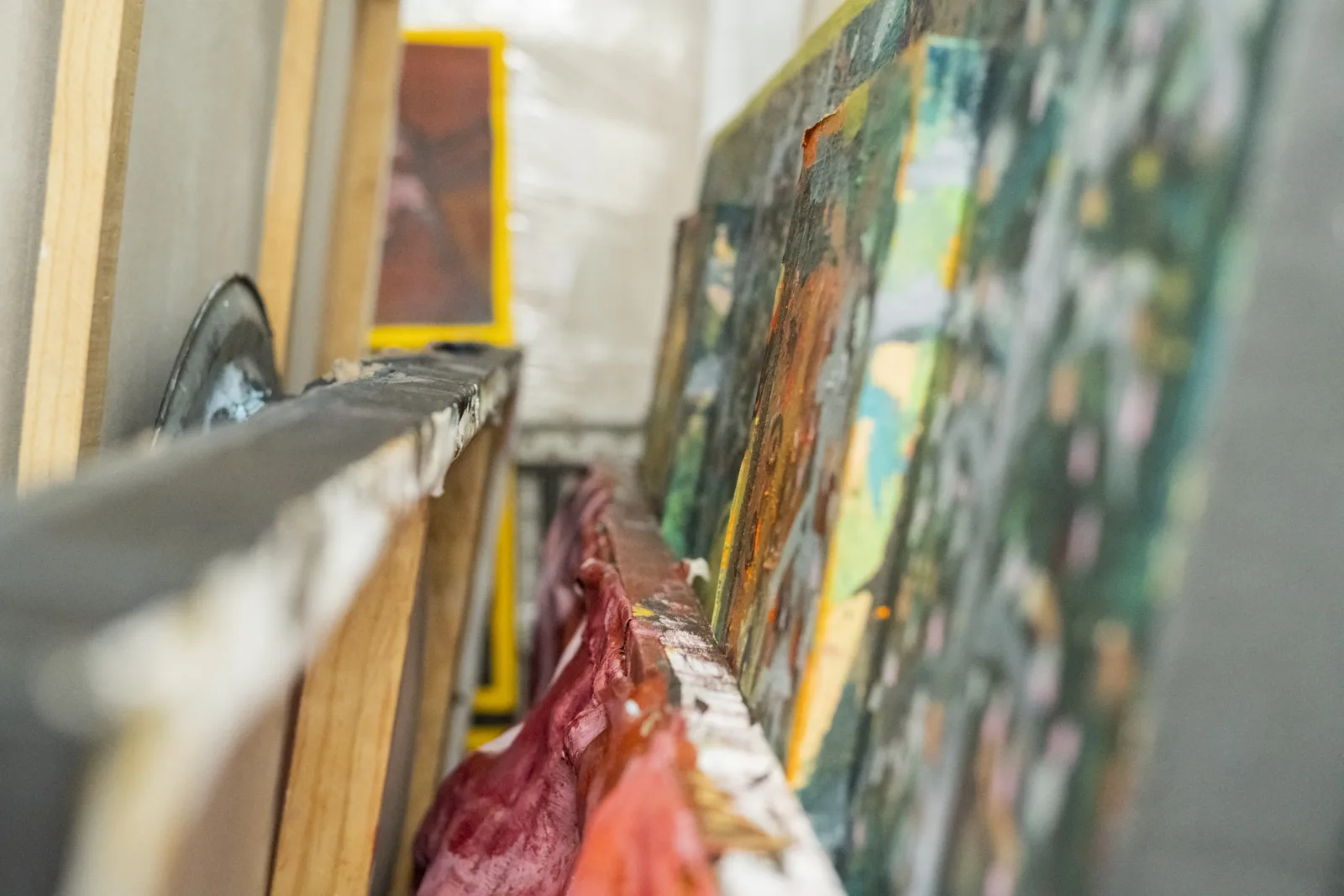
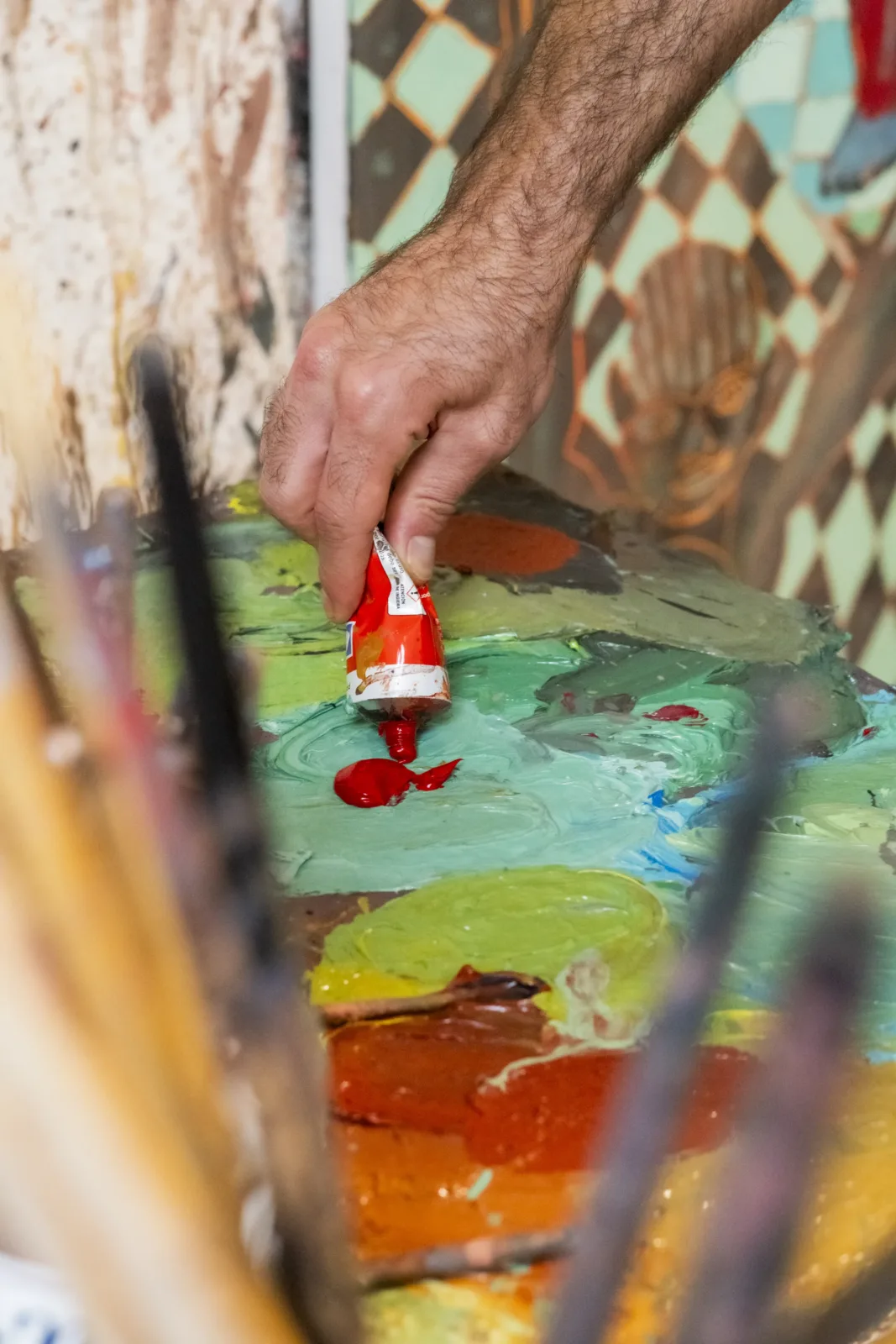
In his studio, the floor is splattered with color. His palette is a mound of green, red, and orange oil paint. The edges of the canvases hold layers of hardened paint. He works mainly in oil. The surface holds the decisions, mistakes, and changes of direction that are part of his process.
“It’s not as beautiful or as exciting as it looks,” he says. “It’s a difficult career.”
There are days of frustration, hours when nothing works. And others when something shifts: he stops thinking about every move, and a feeling arrives that he struggles to put into words.
That relationship with what cannot be explained goes back a long way. His mother was a psychologist, and their home was full of masks, figures, and paintings of archetypes tied to psychoanalysis. Alex grew up looking at those images without knowing how long they would stay with him.
“I think it seeped into me unconsciously,” he recalls. “That more magical side of art. Because for me, art isn’t rational.”
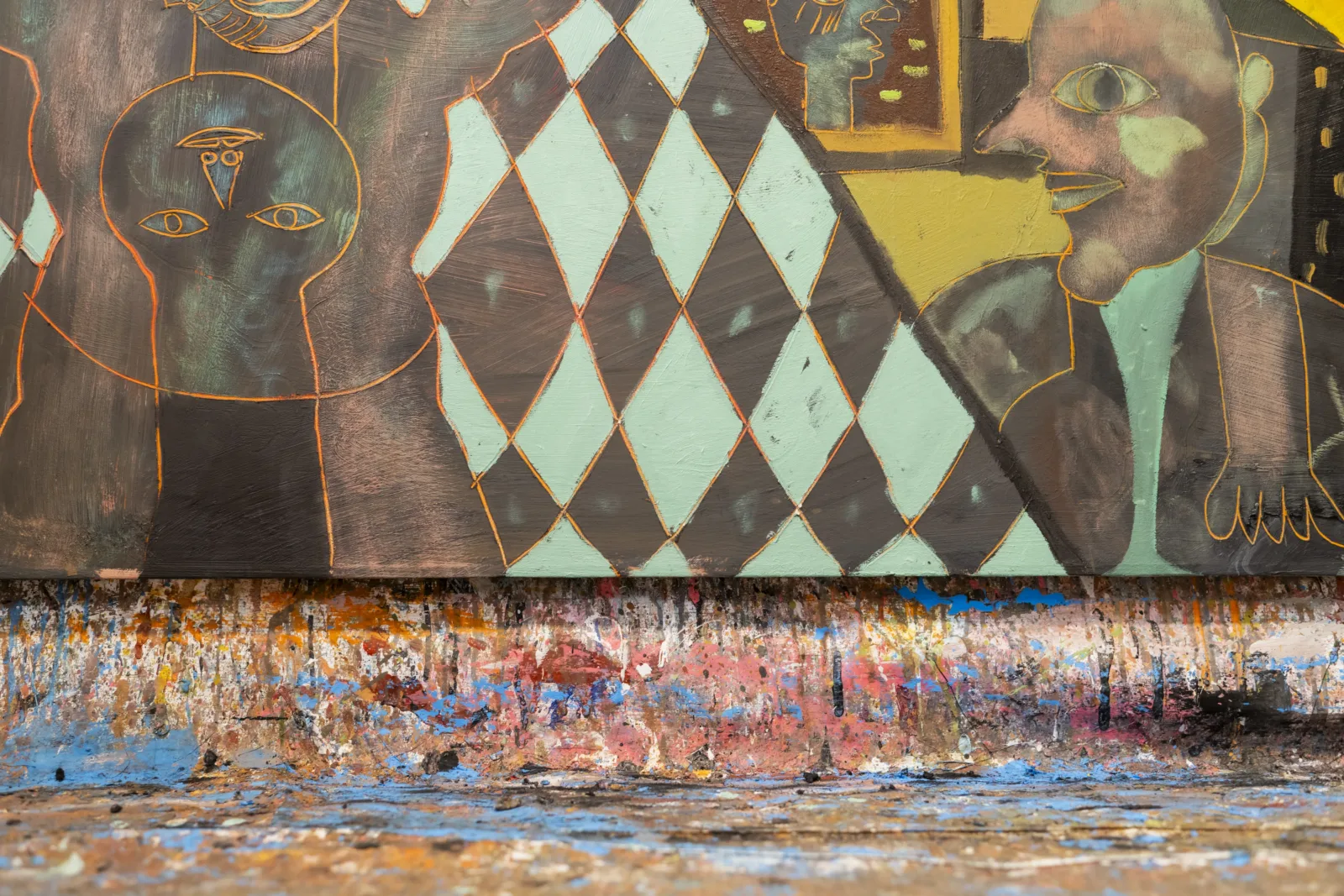
His paintings are inhabited by faces seen head-on and in profile, bodies that are at times elongated, open hands, and animals that seem to have wandered out of a dream. Sometimes the figures have more eyes than they need. The everyday lives alongside something strange, spiritual, hard to name. You don’t need an explanation to stop and look.
Nor does he believe it’s the artist’s job to offer one.
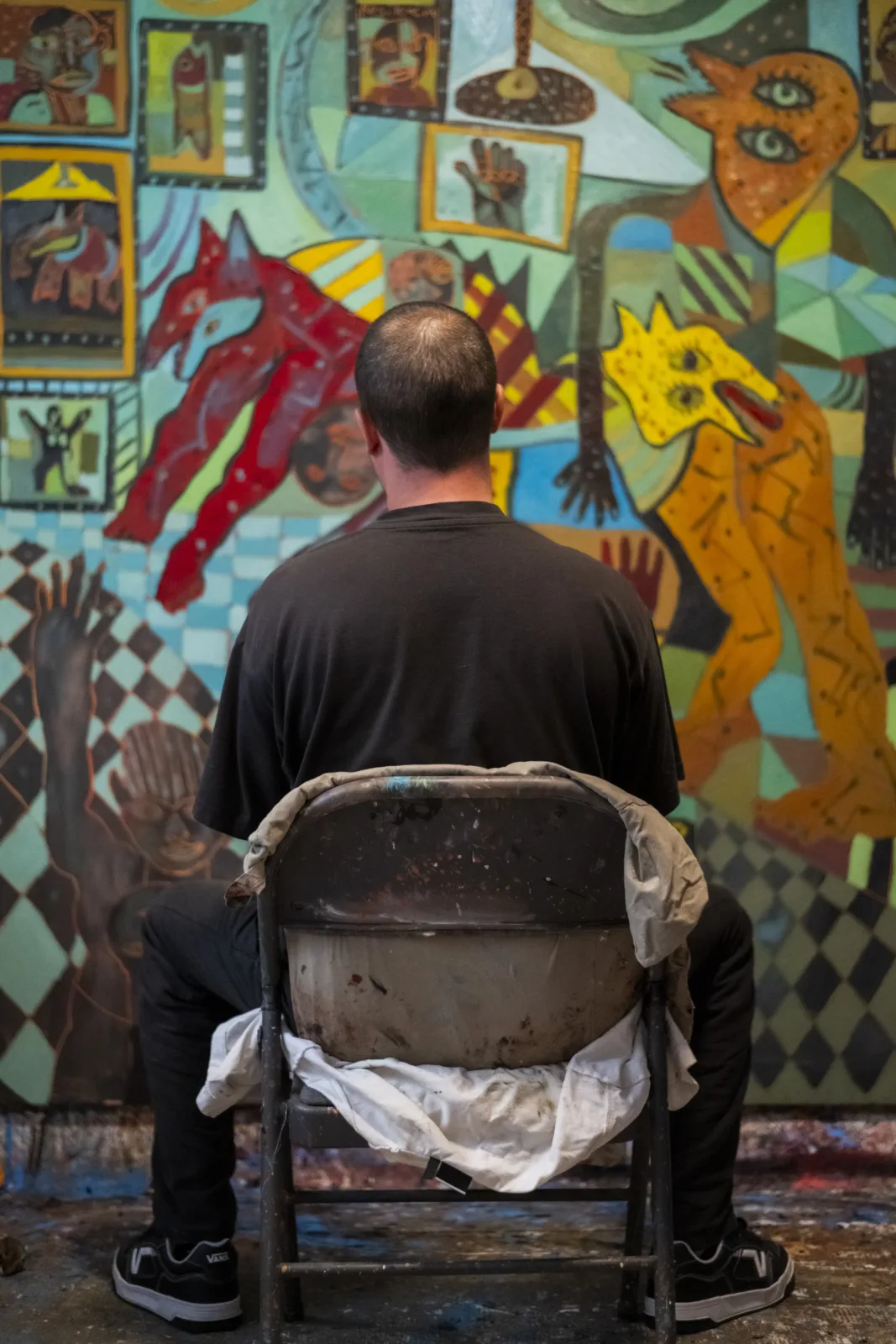
“You reach a state where you disappear. You paint things that come from the unconscious, as if you were just an instrument.”
The freedom he seeks in painting does not mean he has stopped learning. His first drawing teacher was Gilberto Aceves Navarro, who encouraged his students to break with rules, trends, and even his own teachings. Alex later studied with Guillermo Guerrero at Instituto Allende and continued his education in Mexico and Europe. Learning was also a way of discovering what he needed to let go of.
Along the way, someone opened an important door: Isabelle Serrano. In 2016, he had his first solo exhibition in Mexico City. It’s the one he remembers with the most gratitude, not for what it meant to his career, but because it was his first opportunity. Since then, he has exhibited in Mexico and Madrid, though he keeps a certain restlessness about every show. “I always feel the next one is going to be the one.”
Perhaps that is why, when he talks about the artists he admires, he does not begin with their techniques. He names Francis Bacon, Jean-Michel Basquiat, the German Expressionists, and artists from Oaxaca. What he remembers about them is how they made him feel.
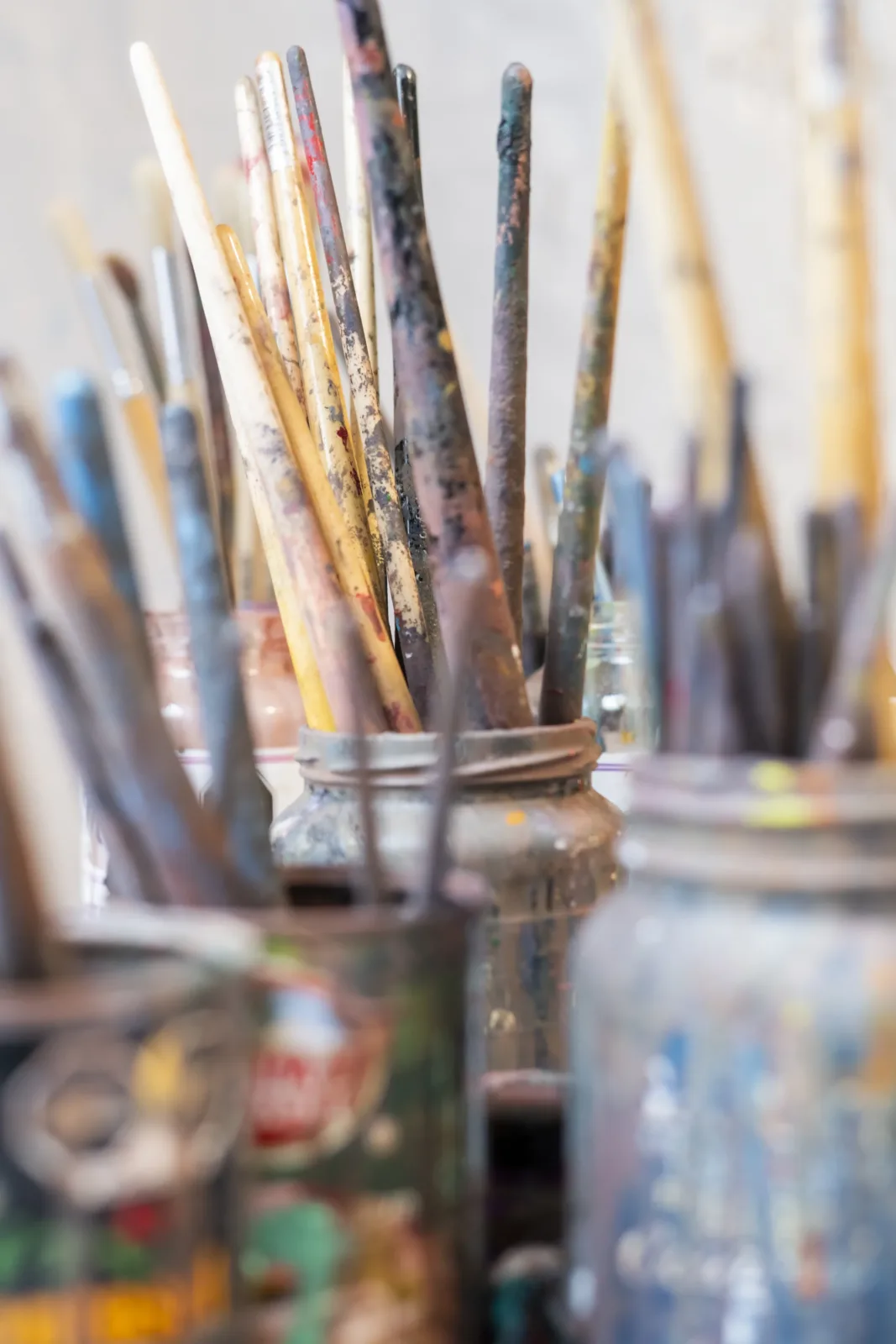
Today Alex is back in San Miguel de Allende, where he was once a student. His work can be found at Galería Potosí, inside Fábrica La Aurora. He values the relationship here between painting and the people who seek it out, but also what happens once a work leaves the gallery.
For him, a painting is complete when someone takes it home. That person doesn’t need to understand what he meant to express. He likes to think the painting will find a new meaning living alongside someone, among their objects and memories, until it becomes part of their everyday life.
Meanwhile, Alex keeps drawing for himself. The notebook he carries throughout our conversation is not meant for an exhibition or social media. These are doodles, a way of staying grounded. Drawing, he says, is like having an extra arm.
If there’s one thing he’d like people to recognize in his work, it’s the courage to begin without knowing what will appear. As children, we all drew, made music, and danced without asking permission or looking for explanations. Over time, most of us stopped.
He didn’t.
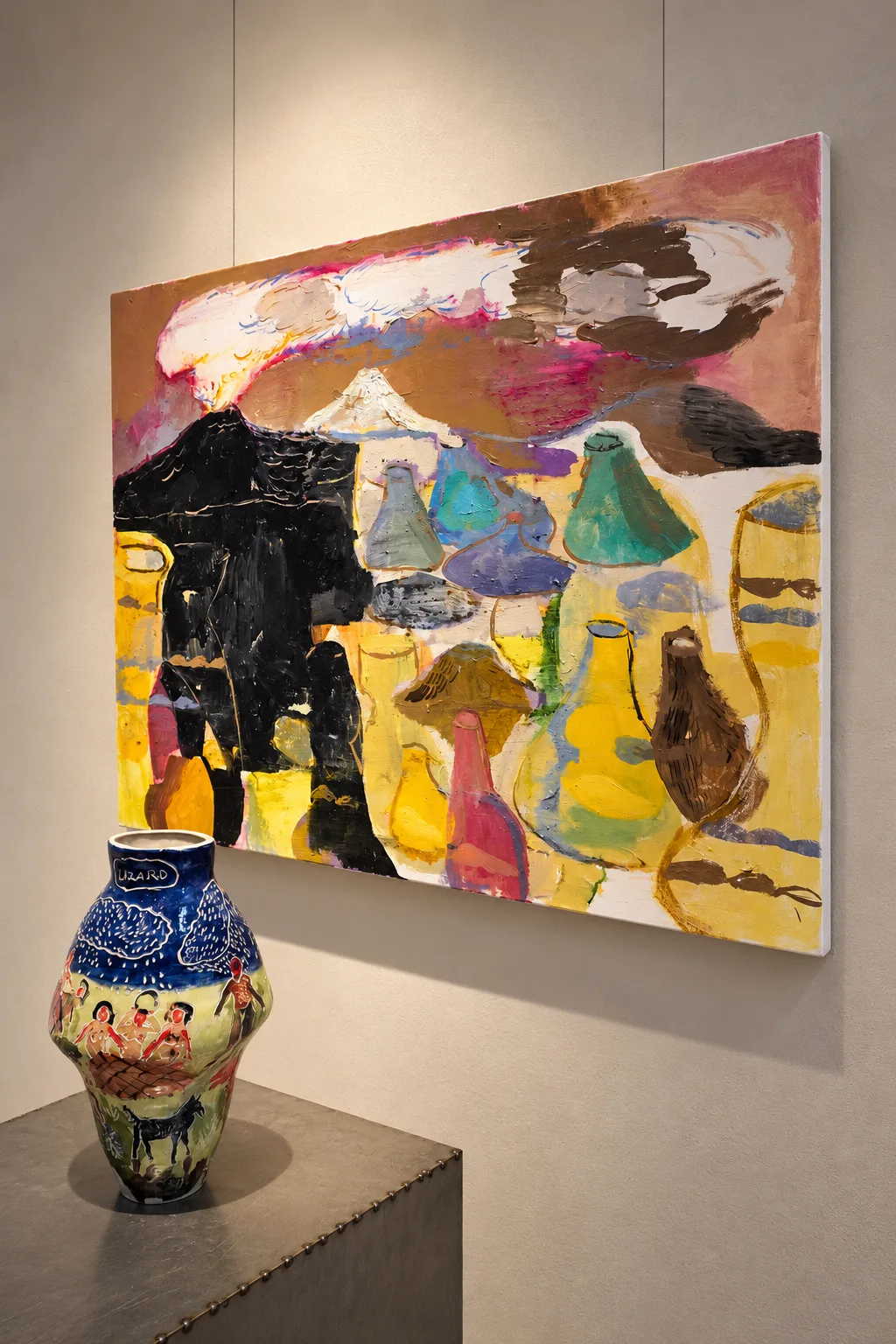
“I’d like people to see in my work the courage it takes to create from nothing.”Alex Lazard